๐Ÿ’ฐ

Capital Gains Deferred

Defer 15โ€“20%+ in federal tax

๐Ÿ”„

Unlimited Exchanges

Repeat as many times as you want

๐Ÿ“ˆ

Wealth Compounding

Keep 100% of equity working for you

๐Ÿ  Who Uses 1031 Exchanges?

  • โ€ขIndividual real estate investors
  • โ€ขCommercial property owners
  • โ€ขResidential rental property owners
  • โ€ขPartnerships, LLCs, and corporations
  • โ€ขTrusts and estates
  • โ€ขReal estate agents growing portfolios

โœ… Key Benefits

Tax Deferral: Postpone capital gains and depreciation recapture taxes
Portfolio Growth: Upgrade property size, quality, or location
Diversification: Swap into different property types or markets
Estate Planning: Heirs may receive a stepped-up basis โ€” taxes may vanish

โš ๏ธ Key Limitations

Primary Residence: Does NOT qualify โ€” investment use required
Boot: Cash/debt relief received triggers taxable gain
Same Taxpayer: Selling and buying entities must match
Time Limits: Strict 45-day ID and 180-day closing deadlines

๐Ÿ“œ Legal Foundation

Section 1031 has existed since 1921. The 2017 Tax Cuts and Jobs Act narrowed it to real property only. The IRS requires a Qualified Intermediary (QI).

IRS Code ยง1031Since 1921Real Property Only
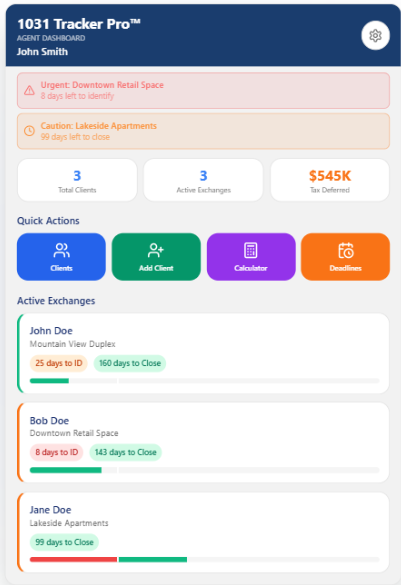
1031 Tracker Proโ„ข mobile app dashboard

Track 1031 exchange deadlines with the 1031 Tracker Proโ„ข.

Sign up for a free trial โ†’
๐Ÿ“‹

Get the Free 1031 Exchange Checklist

Enter your name and email and we'll send it right to you.

This checklist is provided as an educational resource. Every exchange is unique, and this checklist should not replace professional advice from your Qualified Intermediary, CPA, and real estate attorney. Consult with qualified professionals before proceeding with any 1031 exchange.

The 1031 Exchange Guide
Educational Resource for Investors & Professionals

โš ๏ธ This site provides general educational information only, not tax, legal, or financial advice. Always consult a qualified CPA, tax attorney, or licensed Qualified Intermediary before engaging in a 1031 exchange.

Quick Links

Get Started

Important Disclosures & Risk Summary: Investment Risks: Investing in Delaware Statutory Trust (DST) properties and real estate securities involve material risks. These include illiquidity, tenant vacancies, market conditions, competition, lack of operating history, interest rate fluctuations, new supply/softening rental rates, financing risks, development risks, long hold periods, and the potential loss of entire principal. General risks of commercial, multifamily, and short-term lease properties apply. Past performance does not guarantee future results. Cash flow, returns, and appreciation are not guaranteed.

Tax & Suitability Advice: IRC Section 1031 is a complex tax concept. The 1031 Exchange Guide is a general educational resource for navigating like-kind exchanges; it does not indicate suitability for any specific investor, nor does it constitute an offer or solicitation to sell securities. Consult a legal or tax professional regarding your specific situation.

Accredited Investor Requirement: DST properties are restricted to accredited investors (typically requiring a $1 million net worth excluding primary residence, or income of $200,000 individually / $300,000 jointly for the past two years) and accredited entities. Verify your status with your CPA or attorney.

Affiliation & Third-Party Sites: Securities offered through Cabin Securities, Inc., member FINRA / SIPC. Check firm history via FINRA BrokerCheck. Cabin Securities and The 1031 Exchange Guide are unaffiliated. The 1031 Exchange Guide & Cabin Securities are unaffiliated with third-party sites, cannot verify their accuracy, and assume no responsibility for their content. Third-party data and numbers are approximate, general, and educational only.

Jurisdiction Notice: Published for U.S. residents only. Representatives may only conduct business where properly registered. Responses to information requests may be delayed pending registration or exemption verification.

base44
Edit with Base44